Showing posts with label Order of Battle. Show all posts

Sunday, 16 August 2026

Reworked Order of Battle for Union Forces First Mannassas

Above :Union Infantryman (US public domain image) 

I have completed the Fire and Fury OOB for the confederates using the more detailed stand numbers, artillery types, infantry weapons and different morale system. I am using the percentages for the pick up games charts to determine this "chrome" within the OOB. Time to run my attention to the union.  

I have already determined a date for the battle in the first week of August and opted for D6 + 1. A throw of "4" results in a date of 5 August 1861. A little over 2 weeks from the real event on 21 July 1861. I have already determined with a dice roll that the battle will commence with a Union attack somewhere at 11 am. 

So the union counter Order of Battle begins with the commander  McDowell *** 2-0 who sits on top of  the First  Corps HQ counter. As a *** Corps general McDowell  can command up to 3 divisions using the HQ together with 1 further division all in the same or an adjacent hex (only when using the HQ).  In this case he is stacked directly however with I9, I6, I6, I6. So three fairly average sized divisions of 6,000 men and one oversized division of 9,000 men. The I6 divisions will each have two batteries of artillery and the I9 can have 3 batteries. McDowell will also have a Corps artillery reserve of two batteries. McDowell will not be an exceptional Corps commander. As the Union have a further 17 commanders 10 % of which should be exceptional I will allow them 2 exceptional commanders - one divisional and one brigade commander. I will identify them randomly. 

I have allowed each divisional counter on either side a divisional commander for tabletop purposes only which we can name for now and which will operate under Fire and Fury Rules.

All of the Union troops present will be  Green. The only veteran original counter in the East for the Federals is the I3 for the US regulars in Washington (which might be modelled as 2 x 3-5 on the tabletop. Looking at the actual Order of battle for the Union at Bull Run there were in fact 5 divisions. One had no brigade structures so was a collection of volunteer regiments or battalions as it were and the four organised divisions (First, Second, Third and Fifth Divisions) had 4, 2, 3 and 2 brigades (respectively). I am going to model each I6 counter as 3 brigades. The I9 brigade will have 4 brigades. That gives me 13 units to the confederates 15 (14 infantry brigades in 5 divisions and one cavalry regiment). I think the United States Federal artillery regiments should be experienced. Union artillery was in the main superior to confederate artillery throughout the war and certainly in equipment. 

IHeintzelmen is currently in the West chasing Price across Missouri so if we used the 4 remaining historical Divisional commanders from Bull Run these will be Tyler, Hunter, Runyon and Miles.  I will fill out some colour and background for each of these divisional commanders as I assemble them the stands for the tabletop. Some familiar household names will appear as Brigade Commanders the war commences.

Union Army of Northeastern Virginia (effectively a Corps organisation under the rules) 

McDowell - *** Corps Commander 

Artillery Reserve (Maj.  William Barry) 1st United States Artillery Battery 1 (HR) Exp Battery 2 (LR) Exp

First Division - Brigadier General Tyler  (I9 - Tyler)

First Brigade (Col. Erasmus Keyes) 1st, 2nd 3rd Connecticut & 2nd Maine (12/9/6) (MM) Grn

Second Brigade (BG Robert Schenck 2nd NY Militia, 1st and 2nd Ohio (9/7/5) (RM) Grn

Third Brigade (Col William T Sherman) 13, 69, 79 NY and 2nd Wisconsin (13/10/7) (RM) Grn

Fourth Brigade (Col Israel Richardson) 1st Mass, 2nd & 3rd Michigan, 12th NY (11/9/6) (RM) Grn   

Divisional Artillery Brigade (Col Romeyn Ayres) 3rd United States Artillery Battery 1 (LR) Exp Battery 2 (LR) Exp  Battery 3 Exp (RS)

Second Division - Colonel David Hunter  (I6)

First Brigade (Col. Andrew Porter) 8,14 and 27 (10/8/5) (RM) Grn 

Second Brigade (Col Hobart Ward) 1st 4th Michigan, 11th NY (MM) (9/7/5) Grn

Third Brigade  (Col William B Franklin) 5th, 11th Massachusetts, 1st Minnesota and 4th Pennsylvania (11/9/6) (MM) Grn

Brookwards NY Artillery Brigade (Col Brookward) Battery 1 (SB) Grn Battery 2 (RS) Grn

Third Division - BG Theodore Runyan E (exceptional) (I6)

First Brigade (Col Orlando Wilcox) 1st, 2nd 3rd New Jersey & 41st NY ((10/8/5) (MM) Grn 

Second Brigade (Col Ambrose Burnside) 2nd New Hampshire, 1 and 2 Rhode Island (9/7/5) (RM) Grn 

Third Brigade (Col Oliver Howard) 3rd, 4th, 5th Maine & 2nd Vermont (RM) (11/9/6) Grn 

Rhode Island Artillery (Col William Reynolds) Battery 1 (NP) Grn Battery 2 (NP )

Fourth Division - Colonel Dixon Miles  (I6)

Above : Colonel Dixon Miles at Harper's Ferry  (see attribution at site footer

First Brigade (Col Louis Blenker) E (exceptional) 8, 29, 39 NY 27th Pennsylvania (9/7/5) (MM) Grn

Second Brigade (Col Thomas Davies) 16, 18,  71 NY  (11/9/6) (RM) Grn 

Third Brigade (Col Calvin Pratt) 31, 32, 38 th NY (10/8/5) Grn (SB)

Divisional Artillery Brigade (Col Charles Griffin) 5th United States Artillery Battery 1 Exp (NP) Battery 2 Exp (LR) 

My next post will be on the creation of the  tabletop for Mannassas which I am going to have to resize to Fire and Fury from my original plans. 

See you in hell Billy Yank ! See you in Hell Johnny Reb ! 


Reworked Confederate Order of Battle for Fire and Fury for First Manassas


I wrote in my reboot post about my decision to change my tabletop rules from Volley and Bayonet to Fire and Fury. I will update the main tracker in due course but for now I thought it might be useful to try and model the Confederate Order of Battle forces at my First Manassas for the table top from my counter deployment on the map. 

The Fire and Fury Rules state as follows for the combat experience ratings of troops :- 

Green (Grn) - All the troops have seen little or no combat 

Experienced - Some troops have experienced combat 

Veteran - All troops have experienced combat 

Crack - All troops are seasoned veterans with exceptional performance in several battles

On the basis of relative inexperience at the beginning of the war the default should be that troops are Green.  The Volley and Bayonet campaign rules which I am using for the interplay between the campaign board game and the tabletop did provide for the "Stonewall" brigade to begin with Veteran Status. I can model that by having Jackson's brigade itself as Veteran - allowing them a "spirited" status  and conferring Jackson as a divisional commander to have Exceptional status. 

All troops including Militia I feel can progress to Experienced once they have taken part in combat and have taken and/or dealt casualities (I can also make some distinction by using the morale rules - Spirited, Reliable, Unreliable, Dispirited).  I will assume troops are "reliable" unless Militia who will be "unreliable". There are no militia present at this first major engagement. I can build in some nuance with effects for lost battles, poor supply as the campaign progresses. Veteran status I will confer as a battle "award" in line with my old promotion rules. Crack I will apply to veteran units who accumulated  a series of individual outstanding performances over time. 

In terms of battlefield leadership the counters in War Between the States which represent Division, Corps and Army leaders have an initiative rating and combat rating with Army leaders also having a command radius. The default position is the any leader provides a +1 for the Maneuver phase (this is a test to activate) if detached and +2 if attached. Divisional and Corps leaders can also stack those bonuses. The issue is how to decide whether to confer "exceptional" status to a leader model which provides +2 for the manoeuvre phase and +3 if attached. Lyons who unfortunately died both historically and narratively at my first Battle in the Trans Mississipi at Rolla did have a high initiative (4) and combat rating (2) so he may have been a candidate for "Exceptional" leader status. I think for now I am going to be sparing about automatically conferring that status. The "mean" on the counters appears to be a "1" for combat rating so that doesn't suggest exceptional at this stage.  It does appear that during melee any leader who is attached will confer a small +1 bonus - I expect that this is just leading by example. I have discovered however that attaching a divisional commander to a brigade stand is a risky business. There are good fallen leader tables that I can apply and will give an indication as to whether a counter is temporarily or permanently lost. I think as a base rule any leader counter can have his "base" conferred with exceptional status if the counter suggests this. The counters for Beauregard and Johnston have combat ratings of "1" and initiative of "3". I am not going to confer Exceptional status and I will reciprocate that to McDowel on the union side. 

Where I do not have a counter for a divisional commander I will generate one for each map counter for the first battle but I think just dice randomly to see if the base achieves the status based on the relevant percentage at their first appearance. So a 10 % chance for the union and 20 % chance for the confederates. Obviously brigade commanders may eventually appear as divisional or corps commander counters on the map as the game progresses and I can look at the suggested status from the counter in due course. 

There is also the option on the tabletop to model exceptional Brigade leaders who are inherent within a brigade (also though these can be depicted by a single hero figure).  These provide This provides the option to model exceptional brigade commanders when they appear in a historic order of battle e.g. Jackson and would confer a +1 for manoeuvre and +1 when in melee. The Fire and Fury "pick up" battle generator gives a good indication for a % of exceptional leaders at different stages of the War (early, middle and late). 20 % of confederate commanders at the beginning of the war can be rated as exceptional and 10 % of union commanders. I think I will randomly select (over and above Jackson) the correct percentage of brigade commanders to be Exceptional in a battle. That status can remain with them. I will promote brigade commanders to exceptional if warranted by performance. 

The next problem is how to model the size of brigades. Using Volley and Bayonet one strength point on a map counter represented roughly 1,000 men and 1 strength point for a Brigade stand 500 men. On this basis an average divisional map counter with a strength of 4 I could easily double up to read as two brigades with a strength of 4 each. So a division of 4,000 men contained two large brigades with 2,000 men each. Historically the development of the Union favoured a Corps structure in which each division packed a larger number of brigades. A Confederate division was more akin to a smaller Union Corps. The Union favoured a larger number of Corps with fewer divisions. Looking at the Order of Battle for any Gettysburg scenario demonstrates that. I think this structural issue should be modelled within the counter generation and points system. There is a distinction in the counter generation system for how confederate units received fresh recruits to keep up their strength over time whereas Union units were built from freshly raised regiments of 1,000 men which essentially were allowed to deplete over time. 

The overall troop/stand ratio in Fire and Fury is usually one stand for 200 men at the larger battle scale. Sometimes a smaller troop ratio is used as 150 men per stand in Western battle scenarios where the armies tended to be smaller. I will stick with a stand ratio of 200 which has the advantage of dividing neatly into map counter point of 1,000. Brigades obviously varied in size (and will definitely do so as I accumulate battlefield losses within counters). The "paper strength" of Confederate and Union brigades at the outset of war were supposed to consist of roughly 4,000 men (or slightly larger) on paper with 4 regiments of 1,000 each. The reality with straggling, disease and recruitment problems produced brigades of 2,500 men even from the outset which over time shrank further in size as the war progressed. The stand based system in Fire and Fury gives me the opportunity to model that variation by looking at historic Orders of Battle. There is the scope for large variations in brigade size and the opportunity to model larger brigades by using formations such as supported lines. I have my counter strengths to give me some indication in any event. 

Brigades should not be "uniform" on the battlefield and I will try to include some variation. I can perhaps look at the historic OOB to give some indication.  Brigades should not really exceed 2,000-3,000 size so 10-15 stands in size. 

There is yet another variable to build in terms of weaponry. Each infantry brigade will be armed with Rifled Muskets (RM), Mixed Muskets (MM) Smoothbore Muskets (SM) or Repeaters (R - but much later in the war for the Union and in very small numbers. Again I can use the "pick up" percentages for the early war. I think I will confer the charge bonus for Rebel Yell of +1 for a charge as this is a balance to the tables for generation of weapon are types and superior artillery of the Union. 

I will continue to model artillery as best I am able on the Corps and Divisional Scale. There is a larger variety of artillery designations in the Fire and Fury rules :-

Light Rifle (LR) 10 pound Parott/3 inch Ordnance Rife;

Heavy Rifle (HR) 20 pound Parrott in small numbers in both armies;

Napoleon (NP) model 1857 12 pound gun which was one of the most popular field pieces in increasing numbers throughout the war

Smoothbore (SB) model 1841 6 pound smoothbore which was used early in the war by both sides and replaced by more effective models (see above) but used by the confederates throughout in the Western theatre;

Rifle and Napoleon (RN) Union Western Theatre batteries and Confederate batteries often had a mix of types; and

Rifle and Smoothbore (RS) Early war batteries on both sides and Confederate Western batteries up until the end of the war can have a mixture of these two gun types. 

I will again look at the "pick up" suggested percentages to try to model the artillery that I am importing into map counters of Corps and Divisions in appropriate percentages dependant on side and theatre. It seems that divisions typically had between 2 and 4 batteries of 6-8 guns each with larger divisions obviously having more batteries. 

My inclination is to give each Corps commander initially 2 batteries of artillery and an average size division a further two batteries (3-7,000 strength) and oversized divisions (8-10,000 strength an additional battery). Where a counter falls to a brigade size (1-2,000) I would expect only a single battery to be available. This will provide the Confederates with 12 batteries of artillery for this first action and the union 11. 

Essentially I am playing a "large game" and not a simulation and I am as much involved with telling battlefield and campaign stories. Really as long as the make up of armies is not too lopsided or hysterically inaccurate the Fire and Fury rules does provide an amount of "chrome" for my units which will produce some variety on the battlefield.

As the war progresses individual units can upgrade their weaponry when we reach a watershed and percentages change on the tables. My OOB's and tracker will get a little more complex. 

Army of the Potomac & Army of the Shenandoah (each operates as two small Corps on the tabletop) 

The big line from the Order of Battle and Unit Tracker for Manassas in Volley and Bayonet mode read as follows :-

C2409 Manassas Junction, Beauregard****3-3-1, Depot 6-6, 1stCorpsHQ, ST4, C1 (Stuart  Cavalry 2-5) I6 (3 x 4-4 PT NE) I7 (2 x 5-4 PT NE, 4-4 PT NE), I5 (4-4 PT NE, 2 x 3-4 PT NE), Corps Artillery 2-5 R-F , Divisional Artillery 2-5 SB-F PT, 2-5 SB-H PT and J.Johnston****3-3-1I5 (4-4 PT NE, 2 x 3-4 PT NE) I5 (Stonewall), (Jackson "Stonewall" Brigade (50%)  6-5, 4-4 PT NE) Divisional Artillery 2-5 SH-H PT) (High morale 6-5 first stonewall brigade is allowed from House Divided campaign rules set up and now augmented within a mixed brigade). 

I will now convert the Brigades within the games Divisional counters to work with Fire and Fury. All of the divisions fall within normal size so will attach two batteries of artillery. As there are 12 batteries in total I will apply ten batteries within the normal range applying to Confederate early war Eastern theatre artillery and then dice for the final 2. 

Confederate Forces at Manassas 

Joseph E Johnston overall command - this essentially has no "game" effect on the tabletop 

Army of the Potomac  (technically a Corps) - P.G.T Beauregard **** 

Beauregard will not rate as exceptional. Beauregard operates as a Corps commander. 

Corps Artillery - Alexander - Battery 1 -  Purcell (Virginia) Artillery (LR) Grn, Battery 2 Lynchburg (Virginia) Artillery (RN) Grn


First Division - James Longstreet E (exceptional) - that roll of a 9 on a D10 seemed appropriate for the "Old Warhorse". (I6 - Longstreet)


We have a mini galaxy of eventual Confederate 2,3 and 4 stars appearing on the battlefield for this battle. Once elevated by General Lee a little later in the war Longstreet was one of the few commanders in the confederate roll call of the Army of Virginia not to come from that State. He was a Georgia man.  

Divisional Artillery - Shields - Washington (Louisiana) Artillery Battery 1 (SB) Grn Battery 2 (RS) Grn 

Bonham First (Carolina) Brigade (11/9/6) (RM) Grn 11 th North Carolina, 2,3,7,8 South Carolina 


Milledge Bonham was appointed major general and commander of the forces of South Carolina at the outset of the war. He commanded the first brigade at Manassas. In 1862 he resigned his commission to take up his post as a representative for South Carolina in the Confederate congress. 

Ewell E Exceptional Second (Alabama/Louisiana) Brigade (10/8/5) (MM) Grn  5,6 Alabama, 6,8 Louisiana 


Baldy Ewell is another star making his appearance. A regular army officer like many he resigned his commission at the outset of the war when his native Virginia seceded. Throughout the war Ewell petitioned the Confederate government for black slaves to be freed in return for service in the Army of the Confederacy. He was raised as a child in Manassas so should have known the ground well. In the actual battle his brigade was guarding one of the fords a long way downstream and did not see actual combat which was concentrated in and around Henry Hill. 

Jones Third (Mississipi) Brigade (SM) (9/7/5) Grn NE 17, 18 Mississippi, 5th South Carolina 

Stuart's Cavalry E (exceptional)  (6/4/2) (RC) Exp  

Second Division - Jubal Early (I7 Early)


Jubal Early began life as the commander of the 24th Virginia Regiment but I will give him a one of the divisions for Manassas as he was promoted immediately after the battle. I will hand over command of his brigade to Kemper.

Divisional Artillery Battery 1 (RS) Grn Battery 2 Grn (RS) 

Kemper First (Virginia) Brigade  (12/9/6) (MM) Grn NE 7th Louisiana, 13th Mississippi, 7th and 24th Virginia 

Cocke Second (Virginia) Brigade (13/10/7) (RM) Grn  NE 8,18, 19 28 and 49 Virginia 

Wheat Third brigade (10/8/5) (RM) Grn 1st Louisiana (not yet the crack "Wheat's Tigers" I don't believe who gave service in the valley but I will paint them as fancy zoaves for some variation from grey and butternut and a little elan, 4th South Carolina


Third Division - Nathan Evans (I5 Evans)

Divisional Artillery Battery 1 (LR) Grn Battery 2 (RS) Grn 

Holmes first (Arkansas/Tennessee) Brigade (10/8/5) (MM) Grn 1st Arkansas, 2nd Tennessee

Garland second (Virginia) Brigade (7/6/4) (RM) Grn  5th North Carolina, 1, 11, 17 Virginia 

Wade Hampton's South Carolina "Legion" third brigade (8/6/4) (SM) Grn  


Whilst unassigned in the ORBAT for Manassas we will designate the Hampton Legion as a brigade and give it a run out at Manassas. The "Legion" was a fully independent force consisting of cavalry, artillery and infantry but for the purposes of the game we will assign it as a brigade to one of Beuregard's divisions. 

Army of the Shenandoah - technically a "corps" Joseph E Johnston 

Corps Artillery Pendleton Battery 1 Grn (RN) Battery 2  Grn (N)

First Division Thomas Jackson E (exceptional) (I5 - Jackson)


I have promoted Jackson to command a division early for game purposes. He can gather the the forces to hold the "Stonewall" on Henry Hill. It is unclear as to whether Bee below was refering to a physical stonewall on the battlefield or describing Jackson as a stonewall. In any event the name stuck and was passed on from the man to the Brigade he led.

Divisional Artillery Rockbridge Artillery (Brokenbrough) Battery 1 Grn (SB) Battery 2 Grn (RS)

First "Stonewall" Brigade (Virginia Cummings) 15/11/7 (RM) Vet 2nd, 4th, 5th, 27th, 33d Virginia

Second Brigade (Georgia) Gardner (10/8/5) (MM) Grn  PT NE 7th, 8th Georgia

Second Division Bartow (I5 - Bartow)

Divisional Artillery (Culpepper/Staunton Virginia Artillery) Imboden Battery 1 Grn (RS) Battery 2 Grn (SB)

First Brigade Bee (Mixed) (10/8/5) (RM) Grn NE 4th Alabama, 11th 2nd Mississipi 


"Mississipi ! There is Jackson standing like a stonewall. Let us determine to die here and we will conquer ! Rally behind the Virginians". And the rest is history. 

Second Brigade Kirby Smith (7/6/4) (SM) Grn 1st Maryland, 3d Tennessee 

Third Brigade Fisher (8/6/4)  (RM) Grn 6th North Carolina, 10th Virginia 


See you in hell Billy Yank ! See you in hell Johny Reb ! 


Saturday, 6 April 2024

Confederate Order of Battle for the Campaign First Manassas


I have not managed to post at all on this website since before Xmas. Life has got away from me a little bit with my parents who are unwell and family. 

I hopefully have some blue water for a few months and can refocus on this project. The "state of play" is that it is turn 1 of August 1861. I am off on holiday to Mull with my wife and a few friends in the first week of May. A great target would be to get the first big battle done by then or have it ready to be soon after my return. 

I have now purchased 6 of the cheap plastic fold down tables. I do have a silver wedding anniversary next year coming up so hopefully they won't go to waste as bars or buffet tables if we had some sort of celebration here. Another huge order of roads, creeks and hills from my basic scenery supplier of choice S&S in the UK have arrived. They are superb and will do me a lifetime at all scales up to 15 mmm. I have also purchased a large amount of foam board for creating contours under my printed terrain cloths. 


I have started to plan out the roads and main creek from a number of resources. On the above photo Henry House Hill is the small hill in the in the rectangle of roads on the left hand edge of the table. 


I have had one supplier disappointment. Geek Gaming Mats printing machine broke (according to their website and information) and once it was replaced I made the exact same order of two more  "Autumn" fleece 6 x 4 mats so that I could make a huge 12 x 6 foot table. Unfortunately the new prints are coming up a different tone as you can see in the above picture. It's not terrible I know but I can see it and and it is offending my OCD ! I am investing in kit for a retirement of gaming but I don't have bottomless resources. It will be fine once the whole table is "dressed". If I add a little bit more to the look for each battle and continue to paint my bases I should be able to create some wonderful Civil War "soldier porn" of legendary Scott Mingus proportions ! This is all aspirational unless I get my head down and paint. They only have to paint themselves once and the scenery is super fun.

I think I just need to set aside 2 hours for three times a week and one of the weekend days for the rest of May. The rest of May and June should provide some good opportunities but I am conscious that the anniversary of creating this site may soon roll around with my having taken a year to game the first month. It really doesn't matter though. Back to the main event !  

Confederate Order of Battle 

The Confederates  at the historic battle were comprised of two "armies" which were made up in effect of single Corps sized components. By the 21 July 1861  the Army of the Shenandoah under Jo Johnston had managed to slip away from the Union forces outside Winchester and move across by rail to Manassas Junction. This was occurring from about 3 days before the battle with the final forces arriving as the battle was occurring. Famously Jackson arrived at Henry House Hill as General Bee's brigade was falling out. They rallied behind Jackson and the Virginians "standing like a Stone Wall" and the tide was turned. 

In my campaign Jo Johnston has been at Manassas Junction since the second week of July. Jo Johnston was the senior general and will take overall command of the forces on the day. I will allow however Beauregard also to act as a "corps" commander (without an HQ up to his counter command span 3). Like the Federals I will model each division counter as 2 or 3 "named" brigades and list the regiments as appropriate and provide each division with a divisional commander. 

The main difference I can see in the starting Corps permitted by the V&Bayonet campaign rules for the early war is that confederate Corps have a small cavalry reserve whereas Union corps have a small corps artillery brigade as a reserve (usually rifled pieces so parrot guns). Cavalry is modelled from counters in my campaign as separate purchases under the War Between the States boardame rules. My union Order of battle has provided them with 5 brigades of artillery (roughly ten batteries). I don't believe that the Confederates had less artillery per se. The difference in the model corps in the V&B campaign reflects the greater preponderance of Confederate cavalry in the early war which is already a "thing" in my game with the cheaper confederate cavalry points. I think I will allow confederate HQ's (only) not leaders) an artillery reserve but limit this to a SB-H PT brigade rather than rifled field artillery at this stage of the war. I am not purchasing artillery within the boardgame recruitment cycle so I just have to come up with something fair and representative. Overall union artillery was superior in numbers and effectiveness in the war as a whole as I understand it. Certainly in terms of "kit" and quality of ordanance until large amounts of Union material was captured. There was no criticism of confederate gun crews but they were hampered by inconsistent charges with a tendency to explode early and confederate battalions were known during the war to plead with the artillery not to fire over their heads ! 

Army of the Potomac & Army of the Shenandoah (operates as two small Corps on the tabletop) 

The big line from the Order of Battle and Unit Tracker for Manassas reads as follows. As the counters are not marked "0" against their PT status they have all clicked up to "1" in their time based progress from Green to Veteran status :-

C2409 Manassas Junction, Beauregard****3-3-1, Depot 6-6, 1stCorpsHQ, ST4, C1 (Stuart  Cavalry 2-5) I6 (3 x 4-4 PT NE) I7 (2 x 5-4 PT NE, 4-4 PT NE), I5 (4-4 PT NE, 2 x 3-4 PT NE), Corps Artillery 2-5 R-F , Divisional Artillery 2-5 SB-F PT, 2-5 SB-H PT and J.Johnston****3-3-1I5 (4-4 PT NE, 2 x 3-4 PT NE) I5 (Stonewall), (Jackson "Stonewall" Brigade (50%)  6-5, 4-4 PT NE) Divisional Artillery 2-5 SH-H PT) (High morale 6-5 first stonewall brigade is allowed from House Divided campaign rules set up and now augmented within a mixed brigade).

So the confederates have 14 brigade stands in total and I think the Union 13. I am assigning Divisional commanders for the sake of the game effectively promoting some of the brigade commanders from the actual day to command groups of  around 3 brigades. 

Confederate Forces at Manassas 

Joseph E Johnston overall command - this essentially has no "game" effect on the tabletop 

Army of the Potomac  (technically a Corps) - P.G.T Beauregard - "1" 

Corps Artillery - Alexander 2-5 R-F PT - Purcell (Virginia) Artillery, Lynchburg (Virginia) Artillery

First Division - James Longstreet "1" 


We have a mini galaxy of confederate 2,3 and 4 stars appearing on the battlefield for this battle. I will take the time over coming posts to do my usual introductions but for now I will consign myself to a few pictures. I spent an inordinate amount of time introducing Lyons for the union for the battle of Rolla only to have him suffer the same fate as in real life ! Once elevated by General Lee a little later in the war Longstreet was one of the few commanders in the confederate roll call of the Army of Virginia not to come from that State. He was a Georgia man.  

Divisional Artillery - Shields - Washington (Louisiana) Artillery 2-5 SB S-H PT

Bonham First (Carolina) Brigade 4-4 PT NE, 11 th North Carolina, 2,3,7,8 South Carolina 


Milledge Bonham was appointed major general and commander of the forces of South Carolina at the outset of the war. He commanded the first brigade at Manassas. In 1862 he resigned his commission to take up his post as a representative for South Carolina in the Confederate congress. 

Ewell Second (Alabama/Louisiana) Brigade 4-4 PT NE 5,6 Alabama, 6,8 Louisiana 


Baldy Ewell is another star making his appearance. A regular army officer like many he resigned his commission at the outset of the war when his native Virginia seceded. Throughout the war Ewell petitioned the Confederate government for black slaves to be freed in return for service in the Army of the Confederacy. He was raised as a child in Manassas so should have known the ground well. In the actual battle his brigade was guarding one of the fords a long way downstream and did not see actual combat which was concentrated in and around Henry Hill. 

Jones Third (Mississipi) Brigade 4-4 PT NE 17, 18 Mississippi, 5th South Carolina 

Stuart's Cavalry 2-5 

Second Division - Jubal Early "1"


Jubal Early began life as the commander of the 24th Virginia Regiment but I will give him a one of the divisions for Manassas as he was promoted immediately after the battle. I will hand over command of his brigade to Kemper.

Divisional Artillery 2-5 SB-H PT

Kemper First (Virginia) Brigade 5-4 PT NE 7th Louisiana, 13th Mississippi, 7th and 24th Virginia 

Cocke Second (Virginia) Brigade 5-4 PT NE 8,18, 19 28 and 49 Virginia 

Wheat Third brigade 4-4 PT NE 1st Louisiana (not yet the crack "Wheat's Tigers" I don't believe who gave service in the valley but I will paint them as fancy zoaves for some variation from grey and butternut and a little elan, 4th South Carolina


Third Division - Nathan Evans "1"

Divisional Artillery 2-5 SB-H PT

Holmes first (Arkansas/Tennessee)  Brigade 4-4 PT NE 1st Arkansas, 2nd Tennessee

Garland second (Virginia) Brigade 3-4 PT NE 5th North Carolina, 1, 11, 17 Virginia 

Wade Hampton's South Carolina "Legion" third brigade 3-4 PT NE 


Whilst unassigned in the ORBAT for Manassas we will designate the Hampton Legion as a brigade and give it a run out at Manassas. The "Legion" was a fully independent force consisting of cavalry, artillery and infantry but for the purposes of the game we will assign it as a brigade to one of Beuregard's divisions. 

Army of the Shenandoah - technically a "corps" Joseph E Johnston "1"

Corps Artillery Pendleton 2-5 R F 

First Division Thomas Jackson "1"


I have promoted Jackson to command a division early for game purposes. He can gather the the forces to hold the "Stonewall" on Henry Hill. It is unclear as to whether Bee below was refering to a physical stonewall on the battlefield or describing Jackson as a stonewall. In any event the name stuck and was passed on from the man to the Brigade he led.

Divisional Artillery Rockbridge Artillery (Brokenbrough) 2-5 SB-F PT

First "Stonewall" Brigade (Virginia Cummings) 6-5 2nd, 4th, 5th, 27th, 33d Virginia

Second Brigade (Georgia) Gardner 4-4 PT NE 7th, 8th Georgia

Second Division Bartow "1"

Divisional Artillery (Culpepper/Staunton Virginia Artillery) Imboden 2-5 SB-H PT

First Brigade Bee (Mixed) 4-4 PT NE 4th Alabama, 11th 2nd Mississipi 


"Mississipi ! There is Jackson standing like a stonewall. Let us determine to die here and we will conquer ! Rally behind the Virginians". And the rest is history. 

Second Brigade Kirby Smith 3-4 PT NE 1st Maryland, 3d Tennessee 

Third Brigade Col. Fisher/Gibbons (tbc)  3-4 PT NE 6th North Carolina, 10th Virginia 

That concludes the Union and Confederate orders of battle. With 27 individual brigades to model I need to paint now something like 480 10 mm figures as well as an awful lot more artillery and caissons. This will actually break the back on the painting I need to do for a long while with the game. They will not paint themselves butI will try and both enjoy the exercise and listen to some more educational material on the War. 

See you in hell Billy Yank ! See you in hell Johny Reb ! 


Wednesday, 20 September 2023

Confederate Cavalry Units


I am waiting on one or two more scenery pieces and have a few more union bases to complete and artillery to paint but in the meantime the Prices' Missouri guard units for my battle of Rolla are complete including the mounted cavalry. 


I went for a very "dressed" and new 1861 look with the yellow cavalry cuffs. I will add some much more tousled and ragtag cavalry units later for the wars progression. These are Pendraken 10 mm confederate cavalry. They come with essentially two poses - carrying carbines at the ready and with sabres drawn for the troopers and then 3 different style command figures - an officer with a curved sabre and a standard bearer and a bugler. I am really pleased with how these have turned out. A few clear rules for painting 10 mm are emerging. Firstly paint the unit and not the figures. Secondly keep the figures tidy but less really is more with the details. A good flag and some shiny weapons and decent cuffs and all is good. Finally keep the paints as bright and light as possible. Any small figure will come up "dark" especially when using a wash - and with washes use a very soft or light shade. I think I am using medium brown from Army Painter. Any darker with the wash and the figures just turn to mud. 


Under the ACW Volley and Bayonet Rules cavalry can be 2 to 4  strength points on a 3 inch square base and is designated as "light cavalry". I am using two rows of 3 bases (20 x 30 mm) with 2 mounted figures on each. The back two bases are mounted as full light cavalry brigades. A full light cavalry base will dismount as a 3 inch x 1.5 inch linear infantry base.  I have yet to settle on the size of my infill dismounted bases. I may just use two 30 mm square bases as two of these will fill up a linear infantry tray. I might be able to fit a horse holder on each at the back and perhaps 4 or 5 other dismounted cavalry figures - possibly also dismounted command. This may not convert across to other rule systems such as Fire and Fury or Johnny Reb III or Alter of Freedom, but I can always do something else for my cavalry with those rules. I will make up some 20 mm squares as well and see what I prefer later. Given my 5 year timespan with this project I am in it for some detail. 


Light cavalry can throw off skirmish cavalry bases of a point each. A 1 point V & B cavalry stand is actually also on a 3 inch square base. So I can use blanks on a big base or  try  a smaller linear base which might be easier ? This would denote the 1 point value and be less confusing and less needy for  blank filler bases. A 1 point cavalry base dismounts as a 1.5 inch square base which would take one 30 mm square base. Can I get 6 figures on a base with a horse holder ? I think so as a small vignette and this would work well for occupying a village or section of wall or fence.  So I think this settles the issue of what to do for dismounted cavalry for other games. Just buy some more dismounted figures and make nice horse handlers etc. and prepare smaller bases. 

The OOB for Rolla has the confederates with a 2 point cavalry counter on tree map (4 strength points for V & B or 2,000 horses) which will come into the game as two separate 2-5 PT cavalry bases. These can of course be broken down each into 4 cavalry 1 points skirmish bases. I think given their numerical superiority it might be preferable to have just two 2-5 bases which will dismount as a 2 point linear infantry base. Either way I will need to make 4 30 mm dismounted cavalry bases. 

I am keen now to crack on with the battle so will not wait too much longer for further supplies of scenery, finish of the extra couple of units (mostly union now) decide the future of Missouri ! 

See you in hell Johnny Reb ! See you in hell Billy Yank ! 


Tuesday, 22 August 2023

Living Order of Battle and Game Tracker


Position at the End of Strategic Turn August  (8) 1861

This Page is a live summary of the position and type of all map units and other important information for both sides. It includes a summary of blockades, political points and developments, supply and personnel points and for each "on map" counter what they "contain" for the tabletop Volley and Bayonet brigade bases which will fight our battles. The Order of Battle is extended to include the factored in artillery. I have also listed all fortifications and how these will translate to the tabletop. 

Map Key 

A/B/C 1234 - Map number and coordinate for unit grouping on War Between the States map (A is the West Theatre North map - B is the West South map including the Gulf coast from North West Florida to Galveston in Texas. I will include names of places on the map - confederate cities which attract supply points will be in bold and names in italics will be confederate sea ports. Supply points provided by cities and ports vary by month e.g. by season/harvest time. New Orleans, Richmond, Nashville, Memphis and Atlanta are major supply cities and increase in supply provision annually. 

Counter Key

Counters in War Between the States are in strength points that represent c. 1,000 men. Volley and Bayonet units/bases have strength points for each 500 men. 

I# Infantry counter and strength, C# Cavalry counter and strength, M# Militia counter and strength G# Garrison counter and strength, HQ Corps HQ, FA# Field Army and Supply Name***(#-#-#) Leader with Star Rating and Statistics (Initiative, Combat Span (****/***** only), Combat Value for Morale), RT River Transport, RF River Flotilla RI Iron Clad NT Naval Transport NF Naval Flotilla, SG Siege Gun, X2 Fort, X3 Fortress, ST# Supply Train and Supply (up to 10 points) DepName# Department and supply e.g. DepMiddle, Depot#/# Depot counter number and Supply (up to 99 points) 

Volley and Bayonet Bases "contained" within the counters at each location are described and using standard notation some examples 6-4  PT/NE DG (a 6 point green infantry base with dedicated artillery with morale 4 operating at 40 % exhaustion within a unit - the no elites designation is lost when promoted but the PT poorly trained designation remains for six months following recruitment), 4-5 (a veteran  brigade stand with morale 5 operating at 50 % exhaustion within a unit, Cav 2-4 PT (a two point green cavalry brigade stand), 2-5 SB-F PT (smoothbore field piece (probably a 12 lb Napoleon) newly recruited) and so on. 

Artillery is assigned to beginning/new units in sensible types and amounts based on the standard V&B Corps and those listed in the House Divided campaign order of battle. That Order of battle details some variations in units from the outset so some regular US units in Western union formations and a stiffer brigade in the confederate Army of the Shenandoah. Each division of 6-9 counter points (12-18 base points) will be assigned initial artillery and forces with multiple divisions and an on map HQ function may also receive Corps artillery as per standard V&B ACW corps by year and upgrades and promotions will occur/can be awarded  quarterly 3 March/6 June/9 September/13 December in accordance with the House Divided campaign rules. 

Finally for tabletop command and control purposes only I may include on an ad hoc basis one or two divisional leaders as appropriate for forces approaching divisional strength or more (c. 6/7,000 men - 6 counter points - 12 base points) where a counter commander is not present but for basic game purposes only. 

Fortifications X2, X3 special cases for Richmond, Virginia and Vicksburg

The War Between the States campaign rules allow a free upgrade of any x2 counter built in Washington or Richmond to a x3 fortress. Rather than have a chance role for the placement of fort (this seems silly when both capitals were fortified from the get go as a strategic imperative)  from July 1861 and with an expenditure of 30 supply points (the average cost for fort placement) both sides can place a fort counter. Washington and Richmond will then commence fortifications/works and siege artillery which translate to the tabletop in accordance with the schedule in the House Divided campaign rules. By 13/61 the counters will be upgraded to fortress counters to designate the advanced state of the works and artillery. I will keep a running tally in the Order of Battle of the State of those fortifications. 

In addition the confederate side has designated Vicksburg as "fortress Mississippi" and at no additional cost it will follow the schedule of fortifications and siege artillery from 8/61 in the House Divided Campaign rules up until 9/61 and receive a x2 counter. On payment of 50 supply points from turn 10 in full or across a number of turns (a below average cost of a fortress purchase attempt) Vicksburg will upgrade to a fortress and will continue to follow the "fortress Mississippi" fortification and siege artillery schedule. 

Fort Monroe  C3118  begins with an X3 counter on the map and and begins the game with 48 " (6" per side of "fort" sections under the Volley and Bayonet rules and 2 brigades of 2-5 SG-SB artillery. As a fortress in the War Between the States Rules can take up to 100 strength points of counters I think the suggested 24 " (6 " per side) is a little small. Equally for a fort to take ten points of counters (perhaps 5 bases at 4 strength points and 2 brigades of siege artillery and it the counters divisional artillery) it will need probably 12 " on each side initially. 

All other existing or built forts X2 counters (e.g. Memphis, Charleston) will have or create 24 " of field works and 2 SG-SB Artillery in two instalments (i.e complete after a quarter). Any newly built X3 counter will have the works upgraded to "Fort" sections in two instalments (i.e complete after a quarter) with 2 additional SG-R artillery brigades. X2 and X3 counters other than those in the campaign set up and Washington, Richmond and Vicksburg will be subject to payment costs in the War Between the States rules but I may dispense with the  "chance" rolls for placement. I am not sure I like the chance roll ? Surely if a side expends the resources it should be able to complete the works. Throwing away say 200 supply points for the confederacy because a 1 in 6 die roll fails to construct a fortress doesn't seem fair. I will probably just allow a build on the payment of the above average chance cost payment (1-4 on D6) - 40 for a fort and then 120 for a fortress. That seems sufficiently expensive for the confederacy to "dig in". Sieges generally were lost in each instance 

Strategic Turn August 1861 

Politics and Blockades  for August 1861 Strategic Turn 

B4026 Pensacola and C3119 Norfolk are blockaded due to union occupation of B4027 Fort Pickens and C3118 Fort Monroe respectively.

 
Supply Points are now now noted with rail points at the end of the Orders of Battle.

Both sides exhausted all Personel Points for the Month (which are use it or lose it in any event). 

The Confederates gambles and Missouri joins the Confederacy. Both sides will receive additional Personal Points in accordance with a Schedule with roughly 2/3's of these going to the Confederacy. The Union gains a point for the failed victory attempt. 

Political Points/Victory Conditions/Neutrality etc. 

Confederate  0 - Union 1 

Two failed appeals by Confederates 7/61  & 8/61 (required 1 or 2 for Kentucky or Missouri  respectively to join the Confederacy and Missouri joined). 1 point to the Union for the second attempt on the table. 

(1) Kentucky Neutral

(2) Missouri Confederate

(3) No Foreign Intervention

(4) No Emancipation Proclamation

(5) Neither side Occupies any Cities (Variant Political Rules 29.11/29.12) or the union the Lead and Salt Mines (Saltville/C0819) 

(6) Union has not cleared Mississippi

(7) Union has not cut Virginia/Tennessee Rail Link

(8) No destroyed or captured Forts or destroyed Army HQ's 

(9) Union has destroyed 3 map strength points 

(9) No replacement of leaders for either side  of Leaders

(10) No additional Volunteer Calls or Drafts 

Confederate Order of Battle following Strategic Turn August (8) 1861  

Gulf Coast/Mississipi

B0153 Galveston M3 (6-4 PT NE

B2732 X2 (48 " field works and 2 x 2-5 SG-SB)

B2628 New Orleans G1, RT (2-4 PT NE)

B2408 M2 (4-4 PT NE - Alabama Volunteers

B3627 Fort Morgan, X2,  G1 (2-4 PT NE, 48 " field works and 2 x 2-5 SG-SB)

B4026 Pensacola (blockaded by Fort Pickens) M2 (4-4 PT NE) 

B2317 Vicksburg Fortifications Projects (see above begins 8/61)

Trans Mississipi

B1705 Little Rock, DepTransMi, ST5, M2 (PT0), G3 (PT(0)  (4-4 PT(0) NE, 6-4 PT(0) NE),

A2517 Ironton Price***2-1 continues to retreat from the lost battle of Rolla, C1, Cawthorn Cav 2-5 PT) M2 (Weightman 4-4 PT NE) 


Tennessee/Northern Alabama

B2802 Memphis,  DepKen/Tenn, X2, ST5, M2(PT0) G3 (PT(0), RT (4-4 PT(0) NE, 6-4 PT(0) NE 2-5 SB-H PT, 48 " Fieldworks 2 x 2-5 SG-SB) 

B4026 Nashville, M2 (4-4 PT NE Tennessee Brigade tbc) ,I3 (6-4 PT NE - James Trapier South Carolina Brigade 2nd South Carolina (Palemeto Regiment and 10th and 19th regiment). 

B3021 New Madrid, M2 (4-4 PT NE)

A 3222 Union City  Polk***2-1, I3, C2 (6-4 PT NE (or 2 x 3-4 PT NE tbc), 2 x Cav 2-5 PT, SB-H PT) 

Atlantic Coast/Carolinas 

C1145 Fort Pulaski, x2, G1 (2-4 PT NE, 48 " field works and 2 x 2-5 SG-SB)

C1641 Fort Sumter, x2, G1, I3,  (2-4 PT NE, 6-4 PT NE, 2-5 SB-F PT, 48 " field works and 2 x 2-5 SG-SB)

C1640 Charleston, DepSCarol/Ga/Fla, M2(PT0), G3(PT0)  2 supply points (4-4 PT(0) NE, 6-4 PT(0) NE) 

C3527 Fort Hatteras & Clerk (Not made), G1 (2-4 PT NE)

C2024 Raleigh, DepSVirginia/NCarol, M2(PT0) G3 (PT))  (4-4 PT(0) NE, 6-4 PT(0) NE) 

Virginia

C1612 2 M2 (2 x 4-4 PT NE)

C2108 Winchester,  I2, ST4 (4-4 PT NE

C2409 Manassas Junction, Beauregard****3-3-1, Depot 6-6, 1stCorpsHQ, ST4, C1, I6, I7, I5 (Check Merger) Stuart  Cavalry 2-5,  2 x 4-4 PT NE , 2 x 6-4 PT NE , 5 x 4-4 PT NE , Corps Artillery 2-5 R-F , Divisional Artillery 2-5 SB-F PT, 2-5 SB-H PT and J.Johnston****3-3-1I5, I5 (Stonewall), (Jackson "Stonewall" Brigade (50%)  6-5, 4-4 PT NE), 6-4 PT NE, 2-5 SH-H PT) (High morale 6-5 first stonewall brigade is allowed from House Divided campaign rules set up and now augmented to a mixed brigade ) 

C4119 Norfolk (Blockaded) M4 (2 x 4-4 PT NE) 

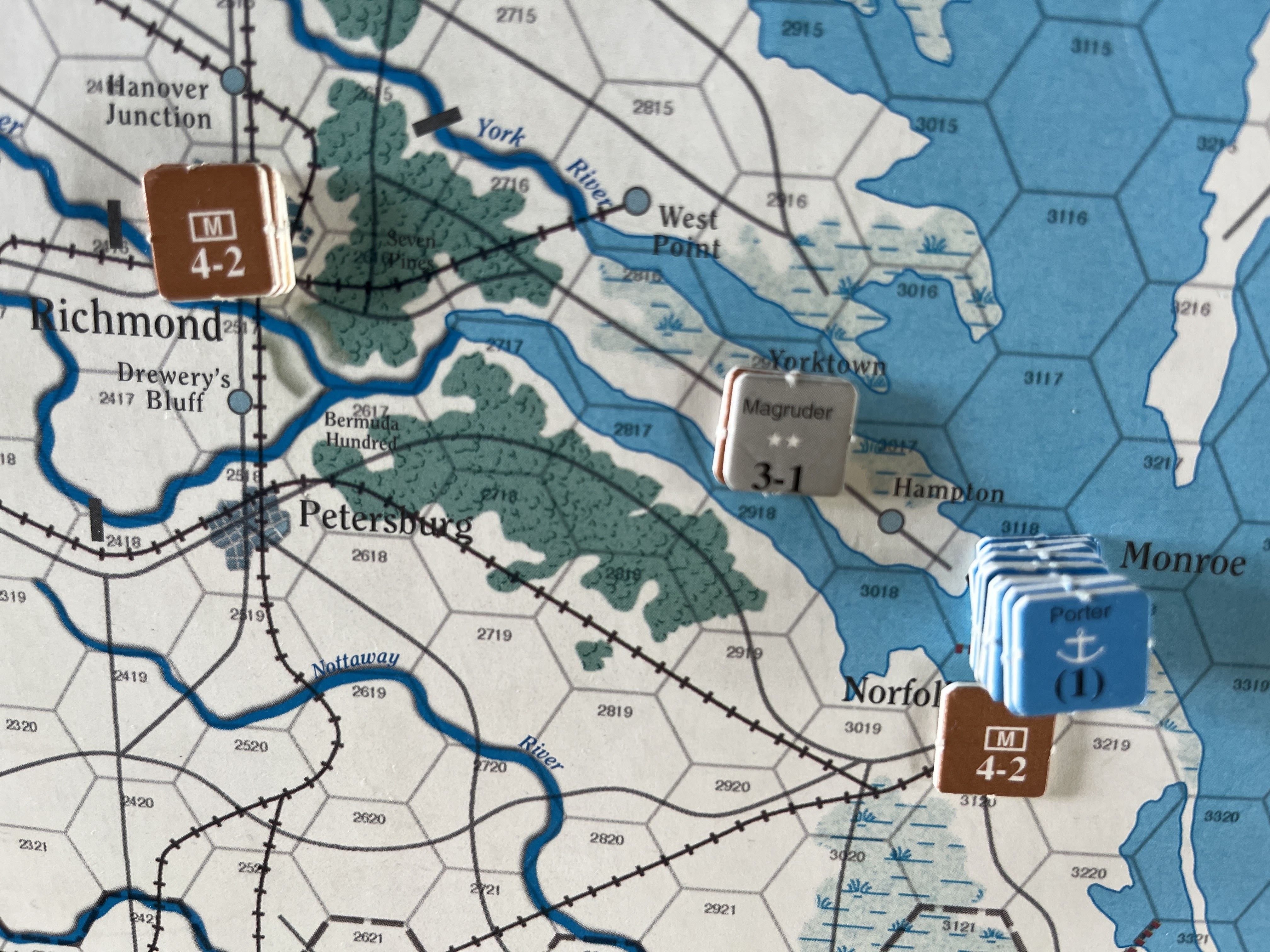
C2108 Yorktown Magruder**3-1, I4 (2 x 4-4 PT NE, with Norfolk notionally 2-5 SB-F PT) 

C2516 Richmond DepNorthVirginia, Fortifications Projects (see above - month 1 24 " fieldworks), M2(PT0), G3 (PT0) (4-4 PT(0)  NE, 6-4 PT(0) NE 2-5 SB-F PT) 

C2512 Aqua Creek M4  (2 x 4-4 PT NE) 

Confederate Production Spiral 

Completing :-

9/61 15 Infantry Points, 6 Cavalry Strength Points (Confederates should receive Hood's Texans 6-5 shock base as one time "ugrade" - select counter), 5 x M2 

10/61 1 River Flotilla, G2, G2, G3, G3, RT

11/61 I3, I3, I4, I4, I10, I10, I3, I3, I3, I3, C2, G10 

12/61 RF, RF 5 x I2(PT1), C2, 2 x I2, I3


Confederate Rail Transport Points 

8/61 - 10 Cap 

Confederate Remaining Supply Points 

8/61 -  23


Union Order of Battle following Move Phase 2 of 7/61 

Gulf Coast 

B4017 Fort Pickens (Blockading Pensacola), G1, X2 (2-4 PT NE, 48" Field Works, 2 x 2-5 SG-SB)

Missouri  

A2712 St. Louis, , DepMissouri, X2, M2 (PT0), G4(PT0) (4-4  PT NE,  2 x 4-4  PT(0) NE 24 " field works, 2-5 SG-SB final works instalment 10/61).

A 2014 Rolla   I1 ( 2-4 PT NE & 1st Iowa The 4-4 can be  ) 

A2414 ST5

A2415 I5 Heintzelman ** (2-1) 1st and 2nd US Infantry Regiment) C1 (US Regular cavalry) (Sigel 5-6 (now crack), Sturgis Cavalry 1-5 (s), Totten 2-5 SB-F PT 4-4 PT NE Deitzlers 1st and 2nd Kansas infantry - now in the I5

A3109 Cairo M4 (2 x 4-4 PT NE Ohio Regiments/Indiana tbc) McClellan*****1-5-2, M2, RT,RT ST5 (4-4 PT NE 4-4 Col John Thayer's Brigade 1st Nebraska and 58th, 68th and 76 th Ohio Regiments )

Ohio & Indiana

A5309 Cincinatti, Dep Ohio M2(PT0), G4 (PT(0) (3x 4-4 PT(0) NE, 2-5 SB-F PT) 

A3005 Springfield M3, M3 (2 x 6-4 PT NE)

A6004 Columbus, M3, M3 (2 x 6-4 PT NE 2-5 SB-H PT) 

A4506 Indianapolis, M3, M3, M2 (2 x 6-4 PT NE, 4-4 PT NE, 2-5 SB-F PT)

A3915 Evansville, Stoneman (** 2-1), DepCumberland, M2(PT0), G4 (PT0) (3 x 4-4 PT(0) NE) 

Virginia/Middle 

C0612 Charleston (West Virginia), I4 (2 x 4-4 PT NE, 2-5 SB-H PT together with next) 

C1311, I4 (2x 4-4 PT NE)

C2206 Harpers Ferry, Depot 5-10 I5,  (2 x 5-4 PT NE,  2-5 SB-H PT) 

C2608 Washington DC,  Hallek ***** 1-2-0, I3, M4, G1, ST6, X2 Fortifications Project (see above) month 1 24 " field works  (6-5 (I3 - 1 st US Infantry

C2508 McDowell***2-0, 1stCorpsHQ, I9, I6, I6, I6 (3 x 6-4 PT NE, 2 x 6-4 PT NE, 2 x 6-4 PT NE, 2 x 4-4 PT NE, 2-5 PT NE, Corps Artillery 2-5 R-F, Divisional Artillery 2-5 SB-H, 2-5 SB-F  PT. Again "F" can be spread out as DG attributes to bases at the cost of 1 artillery point per 2 bases. 

C2609 Alexandria, I5 (6-4 PT NE, 4-4 PT NE)

C2806 Baltimore, DepMiddle, Banks ** 1-1 M2 (PT0), G4 (PT0) NT (at sea just) (3 x 4-4 PT(0) NE,  2 x 5-4 PT NE, 2-5 SB-H PT) 

C2601 Harrisburg, M2, M2 (2 x 4-4 PT NE)

C3401 Philadelphia, DepEast, M2(PT0) G4 (PT0)  (3 x 4-4 PT(0)  NE) 

C3118 Fort Monroe, Butler****0-1-0, Porter(1)(Naval Leader),  x3 (specialist works - see above), M3, M3, M3, Depot 8-10, NF, NF (48 " Fort works (12" each side), 2 x 2-5 SG-SB), 3 x 6-4 PT NE, 4-4 PT NE)


Union Production Spiral 

Completing;

9/61  1 River Flotilla, G11, 4 x I5 (Union should receive under the V&B campaign rules the 1st and 2nd US Sharpshooters each of which is represented by 2 x 1-5 ss infantry skirmish stands - These stands have a 6" range, and hit on die rolls of 5 or 6 when engaged in fire combat. If engaged in melee, they hit on a 6. The stands for each regiment must be in the same divisional counter so I can designate from the I5 counter arriving in 9/61) 2 x RT, ST, 4 x M2, M3

10/61 C2, 3 x C1, 1 Naval Flotilla, 2 x NT, G20

11/61 I10, I10, I2, 4 x I4, I3  2 x NF, 2 x RF 

12/61 5 x C1 I2(PT1) I2(PT1) I2 (PT1) I5, I6 


Rail Transport Points 

8/61 - 21 Cap 

Union Remaining Supply Points 

8/61 - 122 

Next Step - Week 1 of August (8) 1861


Reworked Order of Battle for Union Forces First Mannassas

Above :Union Infantryman (US public domain image)  I have completed the Fire and Fury OOB for the confederates using the more detailed stand...